Most mid-market companies didn’t plan to build AI this way.
One team adopted a chatbot to speed up customer responses. Another started using AI for forecasting or pricing. Someone in marketing rolled out a content tool. IT approved a few licenses. Legal found out later. Leadership saw results, but also risk, confusion, and duplication.
That pattern is common, and it’s understandable.
AI arrived fast. Tools were cheap. Pressure to “do something with AI” came from boards, competitors, and customers at the same time. The easiest response was to let teams experiment.
The problem is that experimentation does not scale.
As AI moves deeper into core workflows, scattered adoption starts to break down. Models behave inconsistently. Data is reused in ways no one fully understands. Security questions pile up. Teams build the same capability three times. Leaders struggle to explain how AI decisions are made or who is accountable when something goes wrong.
This is where an Internal AI Center of Excellence, often called an AI CoE, becomes essential.
Not as a bureaucracy. Not as a research lab. And not as a way to slow innovation.
A well-designed AI Center of Excellence does the opposite. It accelerates adoption while reducing risk. It turns AI from a collection of tools into an organizational capability.
For mid-market firms, this matters more than it does for large enterprises. You don’t have endless budgets, massive data science teams, or tolerance for long missteps. Every AI initiative needs to pull its weight.
This article lays out a practical blueprint for building an Internal AI Center of Excellence that fits the realities of mid-market organizations.
Why Mid-Market Firms Need an AI Center of Excellence Now
In the early phase of AI adoption, decentralization feels productive. Teams move quickly. Wins appear fast. Costs seem manageable.
Then the second-order effects show up.
AI tools begin touching customer data, financial decisions, hiring signals, and compliance-sensitive workflows. Different models produce different answers to the same question. Vendors promise safeguards that no one verifies. Knowledge stays locked inside individual teams. When something breaks, leadership doesn’t know where to look.
At that point, the question is no longer whether AI delivers value. The question becomes whether the organization can govern it without killing momentum.
An AI Center of Excellence exists to answer that question.
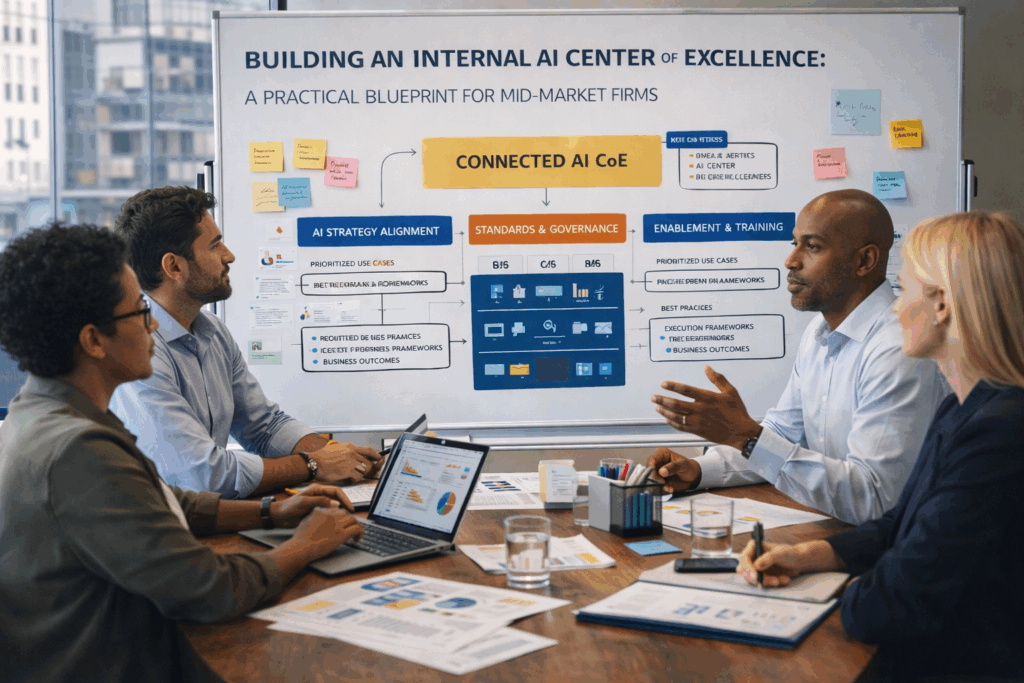
It creates a shared structure for how AI is evaluated, deployed, monitored, and improved. It provides clarity around decision rights. It establishes common standards without forcing every team into the same toolset. It becomes the connective tissue between strategy, technology, risk, and execution.
For mid-market firms, the CoE is not about prestige. It’s about survival and leverage.
What an AI Center of Excellence Is, and What It Is Not
Before defining the blueprint, it helps to clear up common misconceptions.
An AI Center of Excellence is not:
- A centralized team that builds every AI model.
- A gatekeeper that blocks teams from experimenting.
- A purely technical group buried inside IT.
- A compliance function focused only on risk avoidance.
A functional AI Center of Excellence is:
- A cross-functional operating group.
- A standards and enablement layer.
- A governance body with real authority.
- A bridge between business outcomes and technical execution.
Its role is to set direction, provide reusable foundations, and ensure that AI efforts align with business priorities and risk tolerance.
The CoE does not replace product teams, operations teams, or IT delivery. It supports them.
The Core Objectives of an Internal AI Center of Excellence
Every successful AI CoE, regardless of industry, shares a few core objectives.
1. Align AI Initiatives With Business Strategy
AI should not exist as a side project.
The CoE ensures that AI initiatives tie directly to measurable business outcomes, such as revenue growth, cost reduction, risk mitigation, or customer experience improvement. It helps leadership decide where AI investment makes sense and where it does not.
This alignment prevents teams from chasing novelty while missing high-impact opportunities.
2. Establish Consistent Standards and Guardrails
Standards do not slow innovation when they are designed correctly.
The CoE defines baseline expectations for data usage, model evaluation, security controls, explainability, and vendor selection. These standards create a common language across teams and reduce rework.
Guardrails allow teams to move faster because they know the boundaries.
3. Reduce Risk Without Stalling Progress
AI introduces new categories of risk, including bias, data leakage, hallucinations, regulatory exposure, and reputational damage.
The CoE makes risk visible and manageable. It does not eliminate risk. It ensures that risks are understood, documented, and owned.
4. Build Organizational Capability, Not Just Tools
The long-term value of AI comes from people and processes, not licenses.
The CoE focuses on skills development, knowledge sharing, and repeatable patterns. Over time, this compounds into a durable advantage that competitors struggle to copy.
The Right Organizational Model for Mid-Market Firms
Large enterprises often build AI Centers of Excellence with dozens of specialists. Mid-market firms don’t need that, and often can’t afford it.
A lean, federated model works better.
The Federated CoE Model
In a federated model:
- The AI CoE is small, typically 5 to 10 people.
- Members come from multiple functions, including IT, data, security, legal, operations, and the business.
- The CoE sets standards and direction.
- Execution remains with embedded teams.
This model balances control with flexibility. Teams retain ownership of their AI initiatives while benefiting from shared guidance and infrastructure.
Where the CoE Should Sit
The AI Center of Excellence should have executive sponsorship. Ideally, it reports to or is sponsored by a C-level leader such as the CIO, CTO, COO, or Chief Digital Officer.
What matters most is authority.
If the CoE cannot influence funding, vendor selection, or deployment decisions, it becomes advisory only. That limits its effectiveness.
Key Roles Inside an AI Center of Excellence
You do not need exotic titles or a room full of data scientists. You need the right mix of perspectives.
Executive Sponsor
The sponsor provides air cover, prioritization, and accountability. This person ensures the CoE has visibility at the leadership level and can resolve conflicts when needed.
AI Program Lead
This role coordinates the CoE’s activities. The program lead manages the roadmap, facilitates cross-functional alignment, and tracks outcomes.
Business Domain Representatives
These members ensure AI initiatives address real operational needs. They help translate business problems into AI use cases and validate whether solutions actually work.
Data and Technology Leads
These roles focus on architecture, integration, data quality, and model performance. They help teams avoid brittle or unsafe implementations.
Risk, Legal, and Security Representatives
AI governance fails without early involvement from these functions. Their role is not to block progress, but to surface constraints early and design around them.
Defining the AI CoE Operating Model
Structure alone does not create impact. The operating model does.
Intake and Prioritization
The CoE should define a simple intake process for AI ideas. Teams submit use cases with a clear problem statement, expected impact, data sources, and risks.
The CoE helps prioritize initiatives based on value, feasibility, and alignment with strategy.
Design and Review
The CoE provides design guidance rather than dictating solutions. This includes recommended architectures, model selection criteria, and integration patterns.
For higher-risk use cases, the CoE conducts structured reviews before deployment.
Deployment and Monitoring
Standards for deployment, monitoring, and ongoing evaluation are critical. AI does not remain static once launched.
The CoE defines what success looks like post-launch and how models are monitored over time.
Knowledge Sharing
Lessons learned, reusable components, and best practices should be captured and shared. This prevents teams from repeating mistakes and accelerates future projects.
Building the Technical Foundation Without Overengineering
Mid-market firms often swing between two extremes. Either they underinvest in foundations or they attempt to replicate enterprise-scale platforms.
The goal is balance.
Common Data Standards
The CoE should define how data is sourced, labeled, and governed. This does not require a massive data lake initiative. It requires clarity.
Teams should know which data is approved for AI use and under what conditions.
Model Evaluation Frameworks
Not every model needs the same level of scrutiny, but every model needs some scrutiny.
The CoE defines baseline evaluation criteria, including accuracy, consistency, bias checks, and explainability appropriate to the use case.
Security and Access Controls
AI systems often require access to sensitive data. The CoE ensures access is granted intentionally and monitored continuously.
Vendor and Tool Rationalization
The CoE helps avoid tool sprawl. It evaluates vendors against shared criteria and identifies opportunities to consolidate or reuse capabilities.
Governance Without Gridlock
Governance has a bad reputation because it is often introduced after problems appear.
Done correctly, governance feels invisible.
Risk Tiering
Not all AI use cases carry the same risk. The CoE should classify initiatives into tiers based on impact and sensitivity.
Higher-risk initiatives receive more oversight. Lower-risk initiatives move faster.
Documentation That Actually Gets Used
Documentation should be lightweight and purposeful. The goal is traceability, not paperwork.
Teams should be able to explain what the AI does, why it exists, what data it uses, and who owns it.
Clear Accountability
Every AI system should have a named owner. When something goes wrong, accountability should be clear.
Measuring the Success of an AI Center of Excellence
If you cannot measure it, it will not survive leadership scrutiny.
Key metrics include:
- Business outcomes delivered by AI initiatives.
- Time from idea to deployment.
- Reduction in duplicated tools or efforts.
- Risk incidents avoided or mitigated.
- Adoption and reuse of shared components.
The CoE should report these metrics regularly. This builds credibility and secures ongoing support.
Common Pitfalls to Avoid
Many AI Centers of Excellence fail for predictable reasons.
They become too academic.
They centralize execution and create bottlenecks.
They lack executive backing.
They focus on tools instead of outcomes.
They attempt to solve every problem at once.
Avoiding these traps requires discipline and clarity.
A Phased Approach to Building Your AI CoE
You do not need to build everything at once.
Phase 1: Stabilize
Inventory existing AI tools and use cases. Identify immediate risks. Establish basic standards.
Phase 2: Align
Define strategic priorities. Create intake and review processes. Formalize the CoE structure.
Phase 3: Scale
Invest in reusable foundations. Expand governance maturity. Measure and optimize outcomes.
This phased approach keeps momentum high while building long-term capability.
How BizKey Hub Helps Mid-Market Firms Build AI Centers of Excellence
At BizKey Hub, we work with mid-market organizations that want AI to deliver real value without introducing hidden risk.
We help leaders design AI Centers of Excellence that fit their size, industry, and culture. Not copied from big tech. Not buried in theory.
Our approach focuses on operating models, governance frameworks, and execution playbooks that teams can actually use.
AI does not need to be mysterious to be powerful. With the right structure, it becomes one of the most reliable levers a mid-market firm can pull.
The Bottom Line
AI adoption is no longer a question of if. It is a question of how.
Mid-market firms that continue to treat AI as a collection of disconnected tools will struggle to scale it responsibly. Those that invest in an Internal AI Center of Excellence gain clarity, speed, and confidence.
The goal is not control for its own sake. The goal is trust, alignment, and repeatable impact.
That is what turns AI from a buzzword into an advantage.