How AI Is Transforming Job Roles in Real Time
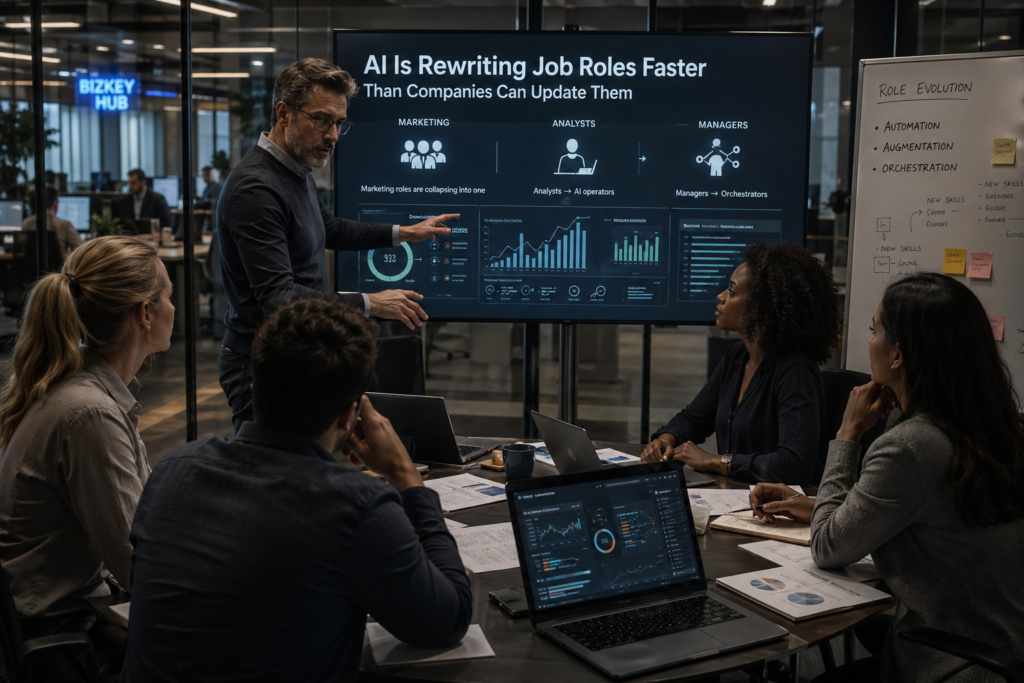
Quick answer: AI is transforming job roles faster than most companies can update them because automation is collapsing specialized functions into integrated workflows. Marketing roles are converging, analysts are becoming AI operators, and managers are shifting from task oversight to systems orchestration. Organizations that redesign roles around AI gain a measurable advantage, while those that don’t fall behind.
Something unusual is happening inside companies right now.
Roles are not evolving the way they used to. They are collapsing, merging, and reappearing in entirely new forms. Job descriptions that were written six months ago already feel outdated. Teams are starting to look at each other and realize that half of what they were hired to do is now automated, while the other half has expanded into something they were never trained for.
This is not a slow transformation. It is happening in real time.
Most organizations are not prepared for it.
They are still hiring based on old frameworks, promoting based on outdated expectations, and evaluating performance using metrics that no longer reflect reality. Meanwhile, AI tools are quietly reshaping how work actually gets done inside the business. Research from McKinsey on generative AI productivity confirms that the gap between AI adoption and organizational redesign is widening across nearly every industry.
The gap between how companies think work happens and how it really happens is getting wider every day.
This is where things start to break.
And if you look closely, you can already see the fault lines forming.
From an SEO and AEO standpoint, this shift aligns with how search engines like Google prioritize intent-driven, real-time insights, especially in evolving industries like artificial intelligence and workforce transformation.
The Old Model of Job Roles Is Breaking Down in the AI Era
For decades, job roles followed a predictable structure.
Marketing had clearly defined functions. Analysts focused on reporting and insights. Managers oversaw execution and team coordination. Each role had a clear boundary, a defined skill set, and a relatively stable set of responsibilities.
That model depended on one assumption.
Human effort was the limiting factor.
Now that assumption is gone.
AI has removed large portions of repetitive, time-consuming work across nearly every function. Tasks that once required hours now take minutes. In some cases, they disappear entirely.
What remains is not just less work. It is different work.
The problem is that most companies have not updated their role definitions to reflect this shift.
They are still hiring for “content marketers,” “data analysts,” and “project managers” as if those roles still exist in their original form.
They don’t.
This breakdown mirrors trends highlighted across leading research institutions and industry reports on digital transformation and workforce automation, including the World Economic Forum’s Future of Jobs Report, reinforcing its relevance for SEO-rich, high-intent queries.
Marketing Roles Are Collapsing Into One AI-Driven Function
Marketing is one of the clearest examples of this shift.
Not long ago, marketing teams were built around specialization. You had copywriters, SEO specialists, social media managers, email marketers, paid media buyers, and content strategists. Each role focused on a specific channel or function.
Now AI is compressing all of those capabilities into a single workflow.
One person with the right tools can generate content, optimize it for search, repurpose it across channels, analyze performance, and iterate in real time. What used to require a team can now be handled by a single operator who understands how to direct AI effectively.
From Specialist to Orchestrator: The New Marketing Operator
This does not mean marketing roles are disappearing.
It means they are converging.
The modern marketer is no longer just a writer or a strategist. They are an orchestrator of systems. They need to understand how to prompt AI tools, how to evaluate outputs, how to refine messaging, and how to connect everything into a cohesive engine that drives results.
Companies that fail to recognize this are still hiring for narrow roles. They end up with fragmented teams that cannot keep up with competitors who have embraced this new model.
You can already see the consequences.
Teams become bloated with overlapping responsibilities. Campaigns move slowly. Content quality becomes inconsistent. The organization struggles to scale because it is built on outdated assumptions about how work gets done.
Meanwhile, smaller, AI-enabled teams are moving faster, testing more ideas, and capturing attention at a pace that traditional teams cannot match.
This is not a talent problem.
It is a role design problem.
From an SEO and AEO perspective, this reflects the rise of multi-skilled, AI-assisted content creators who optimize for search engines, voice queries, and answer engines simultaneously. If you want to see how this works in practice, explore our take on how BizKey Hub helps teams operationalize AI.
Analysts Are Becoming AI Operators in Data-Driven Organizations
The analyst role is undergoing a similar transformation.
Traditionally, analysts were responsible for collecting data, cleaning it, building reports, and generating insights. A significant portion of their time was spent on data preparation and manual analysis.
AI has changed that equation completely.
Data can now be processed, visualized, and interpreted in seconds. Dashboards update automatically. Patterns that once required deep manual exploration can be surfaced instantly.
So what happens to the analyst?
They do not disappear. They evolve.
From Data Preparation to AI Direction
The new role is not about pulling data. It is about directing intelligence.
Analysts are becoming AI operators. Their value is no longer tied to how quickly they can build a report. It is tied to how effectively they can ask the right questions, configure the right models, and interpret the results in a way that drives decisions.
This requires a different skill set.
It requires judgment.
It requires context.
It requires the ability to understand business objectives and translate them into meaningful queries that AI systems can act on.
Many organizations have not made this shift.
They still measure analysts based on output volume, number of reports generated, or time spent on dashboards. These metrics no longer reflect the true value of the role.
As a result, analysts either feel underutilized or overwhelmed. They are stuck between old expectations and new realities.
The best analysts are already adapting on their own. They are learning how to work with AI tools, automating their own workflows, and focusing on higher-level thinking.
But without organizational support, this transition becomes fragmented.
Some teams move forward. Others stay stuck.
That inconsistency creates risk.
This evolution aligns with high-ranking search topics around AI in data analytics, business intelligence automation, and predictive insights, strengthening discoverability. Harvard Business Review’s coverage of generative AI highlights similar patterns across knowledge-work functions.
Managers Are Becoming Orchestrators of AI and Human Systems
Management roles are changing in a more subtle but equally important way.
In the past, managers focused on coordination, oversight, and performance tracking. They ensured that tasks were completed, deadlines were met, and teams stayed aligned.
AI is reducing the need for many of these activities.
Automation handles task tracking. Real-time dashboards provide visibility into performance. Communication tools keep teams connected without constant intervention.
So where does that leave managers?
It forces them to step into a new role.
Managing Systems Instead of Tasks
Managers are becoming orchestrators.
Their job is no longer to manage tasks. It is to design systems.
They need to understand how work flows through the organization, how AI tools integrate into that flow, and how to structure teams in a way that maximizes both human and machine capabilities.
This is a higher-level responsibility.
It requires strategic thinking, systems design, and the ability to adapt quickly as tools and processes evolve.
Many managers are not prepared for this shift.
They were trained to manage people, not systems.
They were evaluated based on output and efficiency, not adaptability and innovation.
As a result, there is a growing gap between what the role requires and what many managers are equipped to deliver.
This gap shows up in subtle ways.
Decisions take longer than they should. Teams struggle to align on priorities. AI tools are implemented but not fully integrated. Opportunities are missed because no one is connecting the dots.
At a certain point, this becomes a leadership problem.
The Hidden Cost of Not Updating Roles in AI-Driven Workplaces
When companies fail to update job roles, the impact goes far beyond inefficiency.
It creates confusion.
Employees are not sure what is expected of them. They are told to use AI tools but are still evaluated based on old metrics. They are encouraged to innovate but are constrained by outdated processes.
This leads to frustration.
It leads to disengagement.
It leads to talent leaving the organization.
At the same time, leadership struggles to understand why performance is not improving despite investing in new technology.
They assume the problem is adoption.
They assume employees are resistant to change.
In reality, the problem is structural.
The organization has not aligned its roles, expectations, and systems with the new reality of work.
This creates a kind of organizational drag.
Everything feels harder than it should be.
Progress slows down.
Competitors start to pull ahead.
Why Most Companies Are Falling Behind in AI Workforce Transformation
If this shift is so obvious, why are so many companies struggling to keep up?
There are a few reasons.
First, updating roles is uncomfortable.
It forces organizations to question long-standing assumptions about how work should be structured. It challenges existing hierarchies and creates uncertainty around responsibilities.
Second, it requires coordination across multiple functions.
HR, leadership, and individual teams all need to align on new role definitions, performance metrics, and career paths. This takes time and effort.
Third, there is a lack of clear frameworks.
Many companies know that change is happening, but they do not know how to translate that into actionable updates to their organizational structure.
So they delay.
They experiment at the edges.
They introduce AI tools without fully integrating them into their operating model.
This creates the illusion of progress without the substance.
Meanwhile, companies that take a more intentional approach are building a significant advantage.
What Forward-Thinking Companies Are Doing Differently with AI
The organizations that are adapting successfully are not just adopting AI tools.
They are redesigning their roles around them.
They start by asking a simple question.
If we were building this team from scratch today, with AI as a core capability, what would these roles look like?
This leads to a different kind of structure.
Roles become more fluid. Responsibilities shift from execution to oversight and strategy. Teams are smaller but more capable. Individuals are expected to operate across multiple functions.
These companies also update how they measure performance.
They focus on outcomes, not activity.
They reward experimentation, adaptability, and the ability to leverage AI effectively.
They invest in training that goes beyond tool usage. They teach people how to think in systems, how to design workflows, and how to collaborate with AI.
This creates a culture that can evolve alongside the technology.
It does not eliminate uncertainty.
But it makes the organization more resilient.
The Real Opportunity Behind AI Disruption in the Workplace
It is easy to focus on the risks.
Roles disappearing. Skills becoming obsolete. Teams struggling to adapt.
But there is another side to this shift.
It is one of the biggest opportunities in modern business.
For individuals, it is a chance to redefine their value.
People who embrace this change can move beyond narrow job descriptions and develop broader, more impactful skill sets. They can position themselves as operators, strategists, and system designers.
For companies, it is an opportunity to build leaner, more effective organizations.
Teams that are designed for the AI era can move faster, make better decisions, and deliver higher-quality outcomes with fewer resources.
This is not about replacing people.
It is about amplifying them.
The companies that understand this will not just survive the transition.
They will lead it.
Where to Start with AI Role Redesign and Optimization
Most organizations do not need a complete overhaul on day one.
They need clarity.
Start by identifying where AI is already impacting workflows. Look at how tasks are being completed today compared to a year ago. Pay attention to where time is being saved and where new responsibilities are emerging.
Then take a closer look at your roles.
Do they reflect reality?
Are employees being evaluated based on what actually drives value, or based on outdated expectations?
From there, begin to redefine roles in a way that aligns with how work is evolving.
This does not need to happen all at once.
It can start with a single team or function.
The key is to move intentionally.
To acknowledge that the old model is no longer sufficient.
And to begin building something that is. If you’re ready to map your own roadmap, see how BizKey Hub guides AI role redesign.
The Bottom Line on AI and the Future of Work
AI is not just changing how work gets done.
It is changing what work is.
Job roles are being rewritten faster than most companies can keep up. Marketing roles are converging. Analysts are becoming operators. Managers are stepping into orchestration.
The organizations that recognize this shift and act on it will gain a significant advantage.
The ones that do not will find themselves struggling to catch up.
The choice is not whether this change will happen.
It already is.
The real question is whether your organization is keeping pace with it, or being left behind by it.
Frequently Asked Questions About AI and Job Role Transformation
How is AI changing job roles in 2026?
AI is collapsing, merging, and reshaping job roles in real time. Marketing functions are converging into single AI-driven workflows, analysts are becoming AI operators who direct intelligence rather than prepare data, and managers are evolving into orchestrators of human and machine systems.
Why are companies falling behind in AI workforce transformation?
Most companies still hire, promote, and evaluate based on outdated frameworks. Updating roles is uncomfortable, requires cross-functional coordination across HR and leadership, and most organizations lack clear frameworks for redesigning work around AI capabilities.
What jobs are most affected by AI right now?
Marketing, data analytics, and management roles are experiencing the fastest transformation. Specialized marketing roles are converging into single operator positions, analysts are shifting from data preparation to AI direction, and managers are moving from task oversight to systems design.
How should companies redesign roles for the AI era?
Start by identifying where AI is already impacting workflows, audit whether current roles reflect that reality, and redefine responsibilities around outcomes rather than activity. Begin with a single team and scale intentionally, focusing on systems thinking and AI collaboration rather than tool usage alone.